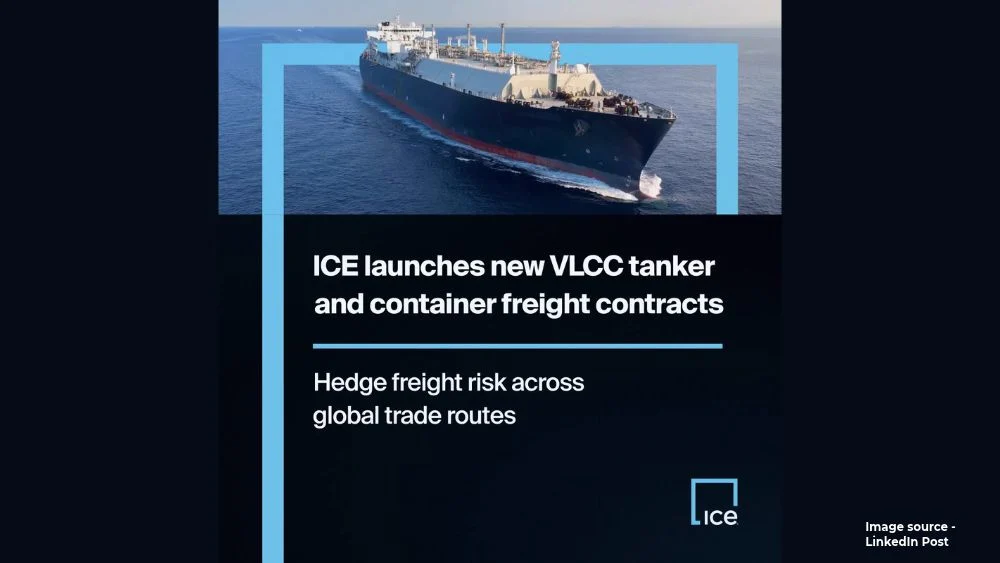
Intercontinental Exchange, Inc. has launched newFreight Contracts and options across key global trade routes. ICE reported a 33% year-to-date increase in average daily volume across its freight markets.
The new freight futures expand hedging options as geopolitical events continue to affect global shipping routes. In particular, ICE introduced tanker Freight Contracts for two major VLCC routes.
The new contracts have covered the TD34 FFA route from Gulf of Oman to China and the TD15 FFA route from West Africa to China. In both the cases, the contracts have been made with cash settlement using the prices assessed by the Baltic Exchange. Thus, it enables the customer to hedge their freight risk when there is limited access to the Strait of Hormuz.
Two more cash-settled container freight average price options have been announced by ICE; namely, FAN for the Asian-North European route and FAW for the Asian-U.S. West Coast route. The newly developed options are based on the futures already introduced by ICE back in April 2026 that use the NYSHEX’s Freight Indices (NYFI). Thus, clients have got another tool to hedge their freight rate risk.
ICE Expands Freight Hedging Options Across Global Shipping Routes
These new additions take ICE’s freight facility beyond 90 contracts. The contracts include more than 30 worldwide routes for both wet and container freight services. Freight services are included in the overall energy network of ICE. Brent and Low Sulphur Gasoil are used to determine the price of the oil. On the other hand, freight contracts determine the shipping price of the oil.
“Freight markets are some of the most closely watched in the world right now as geopolitical developments continue to reshape established trade routes,” said Jeff Barbuto, SVP, Global Head of Oil Markets at ICE. “What makes ICE’s offering so valuable is that the market can manage the full chain of risk, the commodity and the cost of moving it, in one place, as events like the disruption at the Strait of Hormuz continue to affect both.”
“We’re seeing that play out in real time as ship owners reroute vessels, buyers shift to alternative sources of crude, and the market reprices risk across routes far from the Gulf. ICE’s new TD34 and TD15 contracts give customers direct, transparent ways to hedge Gulf of Oman-loading and West Africa-loading voyages for the first time,” continued Barbuto.
At the same time, ICE’s freight agreements serve as an addition to its marine and high sulphur fuel futures. They are used by shipping companies worldwide along with ICE’s major oil benchmarks. They are Brent, ICE Midland WTI (HOU), ICE Dubai (Platts), and Low Sulphur Gasoil.
Explore Finance Tech News for the latest innovations in financial technologies and expert insights shaping the future of digital finance!
News Source: Businesswire.com