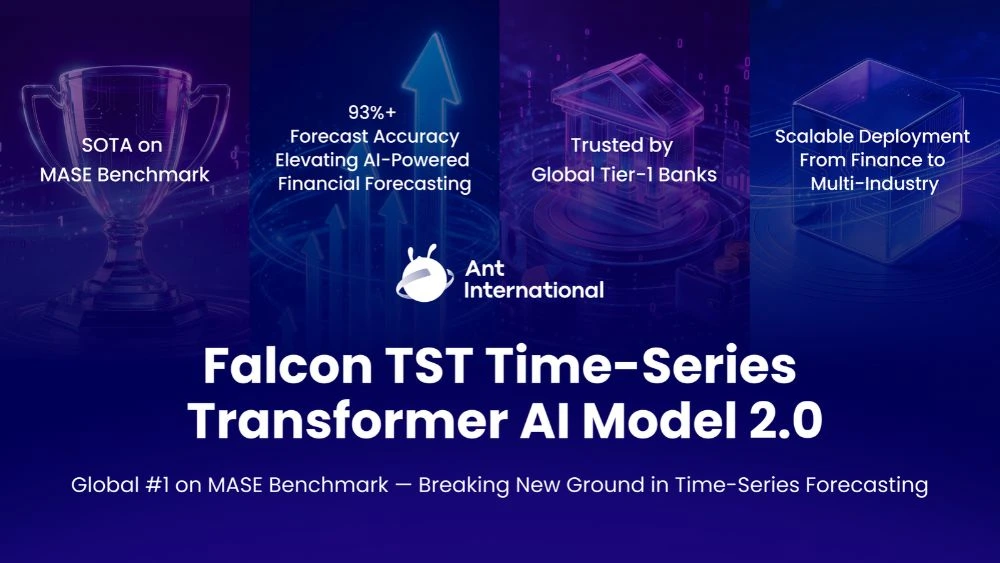
Ant International has launched Falcon Time-Series Transformer (TST) AI Model 2.0. The new model strengthens AI forecasting for finance and cross-border payments. FalconTST 2.0 has achieved state-of-the-art performance on the Mean Absolute Scaled Error (MASE) metric. It reached a MASE score of 0.666 on a leading global benchmark.
The result places FalconTST 2.0 at the top of the benchmark leaderboard. It also puts the model ahead of other TST foundational models from major technology companies. Ant International designed FalconTST 2.0 for real-world financial forecasting. The company initially developed the model for foreign exchange risk management.
However, Ant International plans to extend the technology across other industries. These applications include e-commerce, logistics and aviation.
FalconTST 2.0 Targets Complex Financial Forecasting
Time-Series Transformer models address forecasting challenges that differ from traditional language models. Large language models primarily learn relationships between words and text. However, financial businesses rely heavily on continuously changing numerical information. This data includes transaction values, account balances and settlement flows.
It also includes currency positions and liquidity requirements. Therefore, accurate AI forecasting can directly affect capital efficiency. Businesses need to know when they will require funds. They also need to estimate how much funding they will require. Furthermore, companies must understand which currencies they will need. This information becomes particularly important for global payment institutions.
Foreign exchange management also depends on accurate forecasting. For example, airlines can receive revenue in several currencies. At the same time, they may pay aircraft leases and airport fees in different currencies. They also need to cover operational expenses across multiple markets.
Companies often use foreign exchange hedging to manage currency volatility. However, effective hedging requires accurate estimates of future currency flows. An overly high forecast can result in excessive hedging. Conversely, a low forecast can leave businesses exposed to foreign exchange risk.
Traditional forecasting systems usually use separate models for separate business functions. Retailers may develop sales forecasting models, while airlines may build demand forecasting systems. Financial institutions, meanwhile, typically maintain dedicated liquidity forecasting models. TST foundational models follow a broader approach.
FalconTST learns recurring patterns across different datasets. These patterns include cycles, trends, seasonality and sudden changes. The model learns from areas such as finance, retail, energy, travel and economics. Consequently, it can identify common temporal structures across different industries.
Global Banks Adopt FalconTST for Liquidity and FX Management
Ant International first deployed FalconTST internally for cash flow and FX exposure management. The company uses the model across hourly, daily and weekly forecasting requirements.
Leading global banks have also integrated FalconTST into their own financial systems. Barclays, Citi, Deutsche Bank and Standard Chartered use the model for related applications. Barclays integrates FalconTST into its FX hedging platform, BARX NetFX. Meanwhile, Citi combines FalconTST with its Fixed FX Rates solution.
These implementations mainly support FX risk management for e-commerce platforms and airlines. Standard Chartered also uses FalconTST alongside its SCALE FX system.
The Standard Chartered deployment forms part of the PathFin.ai programme. The programme includes participation from both organisations and the Monetary Authority of Singapore. The banks have now adopted FalconTST 2.0. The updated model has delivered forecast accuracy above 93% consistently.
This accuracy can help financial institutions manage large cross-border payment volumes. It can also help them reduce exposure to currency fluctuations. For global banks, accurate AI forecasting can support better liquidity planning. It can also strengthen financial risk management and treasury operations.
Ant International Expands FalconTST Across Industries
Ant International aims to make FalconTST a reusable forecasting capability. The company intends to apply the technology across customers and industries. Aviation represents one important application area. Airlines manage revenue and expenses across multiple currencies.
Their cash flows can also change rapidly. Therefore, accurate forecasting can support stronger liquidity and FX management. FalconTST already supports FX and liquidity management within the aviation sector. Ant International is now expanding its potential use across e-commerce and logistics.
The company also sees opportunities in other industries with complex forecasting requirements. These include businesses that manage rapidly changing demand and financial flows. Ant International believes reusable AI capabilities can create broader value. A solution built for one customer remains largely customised.
However, a capability that works across customers can become a foundational technology. The same principle applies when businesses can use it across multiple industries.
“Large language models have shown how AI can understand and generate information. FalconTST is about another capability that businesses increasingly need: understanding how the world changes over time, and anticipating what comes next. For us, the value of AI is not simply achieving a better forecasting score, but turning that predictive intelligence into real decisions—how much liquidity to prepare, how to manage FX exposure, and how to allocate capital more efficiently. FalconTST 2.0 is an important step toward making predictive AI a foundational capability for global businesses, across payments, accounts and broader financial services,” said Jiang-Ming Yang, Chief Innovation Officer, Ant International.
“FalconTST helps global businesses — including our own — manage complex cash flow and FX exposure, so they can manage cross-border transactions with greater confidence. With FalconTST 1.0, clients saw real operational value and cost savings from better forecasting. With FalconTST 2.0, enhanced accuracy and precision let us extend those benefits to our banking partners as well as a broader range of customers across fast-moving sectors like e-commerce, travel and fintech,” said Kelvin Li, General Manager of Platform Tech and Senior Vice President, Ant International.
FalconTST 2.0 Adds New Forecasting Capabilities
FalconTST 2.0 introduces several technical improvements for real-world forecasting challenges. These updates aim to improve prediction accuracy across complex datasets.
Advanced handling of missing data:
The model distinguishes missing information from genuine zero values. For example, no bank transactions during a weekend do not indicate zero demand. This distinction helps prevent the model from learning misleading patterns. As a result, FalconTST 2.0 can handle incomplete financial datasets more effectively.
Powerful generalisation across domains:
Through ORBIT, FalconTST identifies common time-series patterns across several industries. These include finance, retail, energy and tourism. This capability allows the model to forecast new business scenarios more effectively. Therefore, organisations can apply predictive AI across different operational environments.
Support for multiple time frequencies:
FalconTST 2.0 supports data with different time frequencies within one architecture. The model can process second-level payment information and hourly treasury requirements.
It can also support daily airline demand and monthly economic indicators. This flexibility allows businesses to apply AI forecasting across different operational timelines. The combination of these capabilities strengthens FalconTST 2.0’s potential beyond financial services. Ant International expects the model to support broader applications across fast-moving business sectors.
Explore Finance Tech News for the latest innovations in financial technologies and expert insights shaping the future of digital finance!
News Source: Businesswire.com