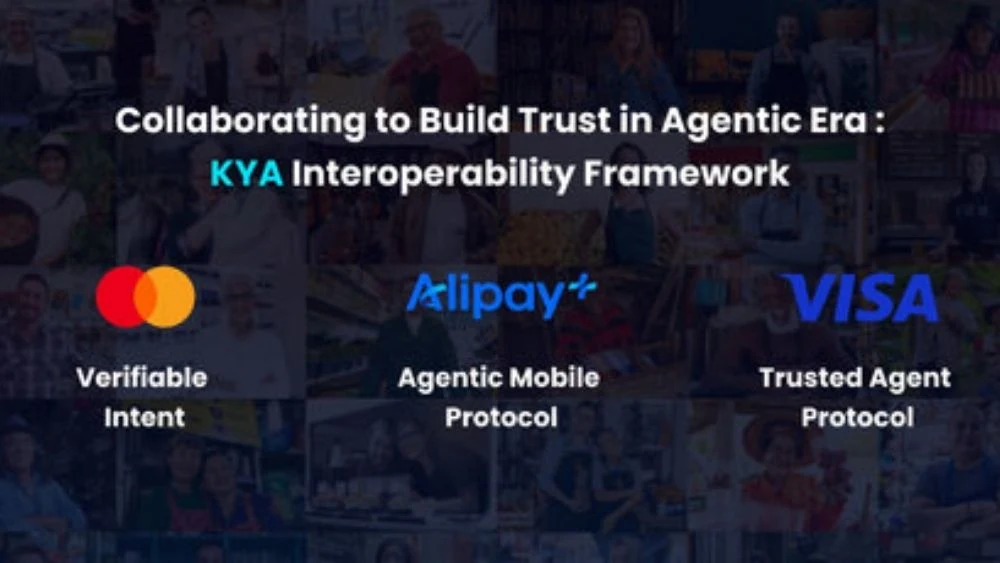
Ant International, Mastercard and Visa have begun working together on Know-Your-Agent interoperability. The initiative aims to develop a framework for onboarding and identification of agents across networks. The framework will support card networks, digital wallets, agent platforms and marketplaces. It will be built on shared principles, while keeping the verification processes of each network.
AI agents are moving beyond recommendations and increasingly completing purchases for users. By 2030, AI agents could orchestrate US$3 trillion to 5 trillion in global consumer commerce. Therefore, the industry needs stronger systems for identifying and managing AI agents. Know-Your-Agent architecture provides a foundation for that approach across payment networks and service providers.
The architecture establishes agent requirements and accountability across the ecosystem. It also verifies agent identities and supports secure transaction execution. Ant International, Mastercard, and Visa have already introduced individual protocols. These include Visa’s Trusted Agent Protocol, Mastercard Verifiable Intent, and Ant International’s Agentic Mobile Protocol. Now, the organizations will explore opportunities to develop common principles across these approaches.
“As AI agents become a bigger part of how people discover and buy, trust must scale with them,” said Rubail Birwadker, Global Head of Growth Products and Strategic Partnerships, Visa. “Visa has played a leading role in creating the trust frameworks that make agentic commerce possible through the development of innovations such as Visa’s Trusted Agent Protocol. Collaborations like this can help create more consistency, better accountability, and greater confidence across the payments ecosystem as AI-driven transactions become more common.”
KYA Framework Supports Trusted Agent Onboarding
The proposed interoperable KYA framework could simplify agentic payment transactions. It will support service providers, agent platforms, and marketplaces across participating networks. At the same time, the framework will maintain strong trust and risk controls. Agents could use KYA and identity frameworks that recognize common trust signals.
This approach could make integrations easier for businesses by reducing technical complexity. It may also help avoid duplicate efforts when verifying agent identities. At the same time, participating networks can continue using their own verification and risk assessment processes.
This balance could help organizations strengthen security without adding unnecessary barriers during integration. The collaboration may also allow new agentic services to enter the market more quickly. For businesses, this could mean lower integration costs, along with greater visibility into trust and potential risks.
“Interoperability across Know-Your-Agent frameworks is essential to making agentic commerce work at scale, giving merchants, platforms, wallets and issuers a consistent way to recognise trusted agents, verify that actions reflect the user’s intent, and preserve accountability across the transaction,” said Pablo Fourez, Chief Digital Officer, Mastercard. “Mastercard Verifiable Intent was designed for this open ecosystem, helping ensure that as commerce becomes more autonomous, every interaction remains secure, transparent and grounded in consent.”
The KYA collaboration focuses on three key areas:
Cross-network Operator Traceability: Each agent will be linked to a verified operator, cardholder or business/organisation. This link will give a better attribution of agent activity.
Certification Requirements: Sharing Each agent will be evaluated according to security and behavioral criteria. These evaluations will help to confirm that agents behave as expected.
Continuous Transaction Monitoring: All agents will be continuously monitored and evaluated. Continuous evaluation and certification will be based on identity and transaction-based signals.
Payment Industry Strengthens Agentic Commerce Governance
The payments industry is Interoperability increasing collaboration around agentic commerce. Trust, common principles, and governance remain central to this development. Agent identity and trust have also become major areas of industry attention. Stronger frameworks can help payment networks manage increasingly autonomous transactions.
Ant International, Mastercard and Visa will build on the Safeguards for Agentic Finance at Runtime (SAFR) framework. The organizations will collaborate through BuildFin.ai to promote joint approaches. The work will focus on verification, accountability and risk management for AI agents. The collaboration will center on payment ecosystems in Singapore.
BuildFin.ai is an industry platform Interoperability convened by the Monetary Authority of Singapore (MAS). The platform is a gathering place for financial institutions, technology providers and researchers. Together, these participants aim to create and scale responsible AI solutions for financial services.
The initiative aims to support secure and scalable agentic commerce. It will help AI agents operate safely across different payment ecosystems. At the same time, the approach will maintain safeguards for consumers, merchants, and financial institutions.
“Interoperable KYA between card and wallet networks is critical for securing trust for our payment partners, platforms and merchants in agentic commerce,” said Jiang-Ming Yang, Chief Innovation Officer of Ant International. “We look forward to expanding collaboration as the industry draws on richer signals — capabilities, behavior, execution performance, and risk data — to enhance trust and simplify transactions for our clients and their customers.”
Explore Finance Tech News for the latest innovations in financial technologies and expert insights shaping the future of digital finance!
News Source: Businesswire.com